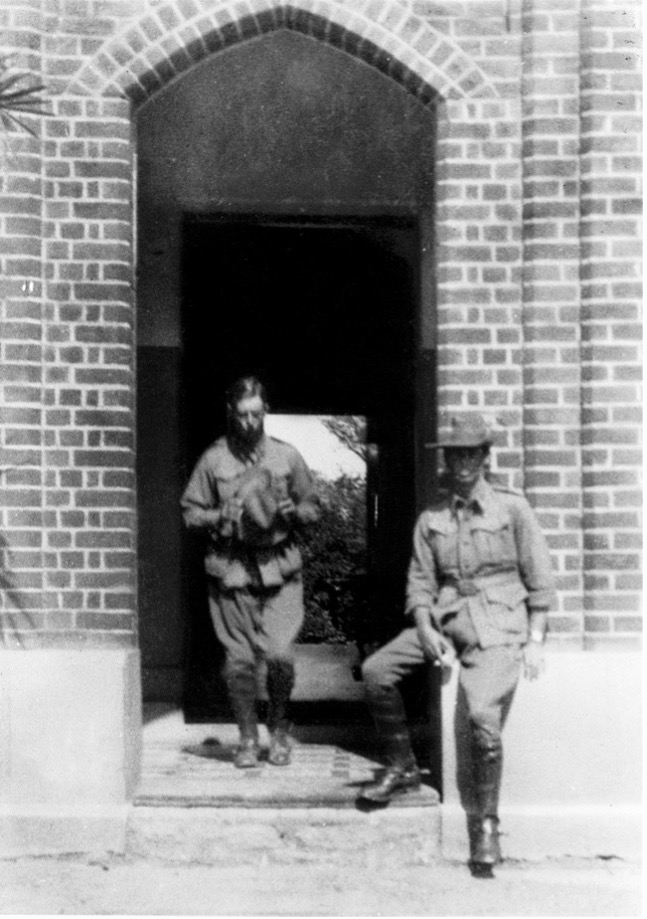
Wilfred L. Harper and Gresley T. Harper
Guildford Grammar School traces its foundations to 1896, when Charles Harper established a school in the billiard room of his family home to educate his children and those of the surrounding district. Sons of Charles Harper, Gresley Harper was born on 16 February 1884, and his brother Wilfred Harper was born on 29 July 1890.
Gresley was an original student in 1896. He was a School Prefect for three years and was a member of the 1st XI Cricket team and the 1st XVIII Football team for two years. At the 1901 sport meeting, Gresley won the Throwing Cricket Ball event. Between 1905 and 1908 Gresley attended St Peter’s College in Adelaide and after a term moved to Trinity College at Melbourne University. He was admitted to the Victorian Bar and in 1912 was admitted to the Western Australian Bar. He was practicing as a solicitor when World War I broke out.
Wilfred attended Guildford Grammar School from 1897 to 1908. He was a School Prefect for two years. Wilfred was not only academically inclined, winning seven academic prizes, but was also a talented sportsman. Wilfred was a member of the 1st XI Cricket for four years and the 1st XVIII for three years. He also held the rank of Sergeant in the Cadets.
At the outbreak of WWI, Wilfred joined the 10th Light Horse Regiment and commenced training in October 1914 at the Guildford Depot along with his brothers, Gresley and Prescott, as well as Bertram and William Brede, Geoffrey Drake-Brockman, Sidney Johnson, Bob Lukin, William Lyall and Vernon Piesse.
Before leaving Perth, Wilfred wrote to his mother from a training camp at Claremont, “Dear Mother, as we won’t be coming home again I must write to you to say goodbye again. We get up at 4am tomorrow and we leave here about 10 o’clock and the day will be spent embarking. We are told that we will leave tomorrow night and will be anchored out in the sea till other boats come along. There has been a big crowd down here today. Plenty of old friends have been down and between jobs we can have a chat.”
The regiment embarked from Fremantle on the Mashobrain two stages, beginning 7 February 1915.
The two Harper boys disembarked in Egypt on 8 March 1915. After a brief period of training, the Light Horsemen agreed to fight as infantry reinforcements as a dismounted regiment. After a period of training, they joined the MEF at Alexandria. They embarked for Gallipoli on the 16 May with ‘A’ Squadron 10th Regiment 3rd LH Brigade. They disembarked at Gallipoli on the 20 May 1915. The light horsemen were not involved in the landing at Gallipoli but after heavy casualties were soon on their way.
The two Harper boys disembarked in Egypt on 8 March 1915. After a brief period of training, the Light Horsemen agreed to fight as infantry reinforcements as a dismounted regiment. After a period of training, they joined the MEF at Alexandria. They embarked for Gallipoli on the 16 May with ‘A’ Squadron 10th Regiment 3rd LH Brigade. They disembarked at Gallipoli on the 20 May 1915. The light horsemen were not involved in the landing at Gallipoli but after heavy casualties were soon on their way.
Gresley wrote from St Andrew’s Hospital Malta, June 14 1915, “Just a few lines to let you know how I am getting on. I was unfortunate in being wounded on the 29 May, when the Turks made a desperate attack on our trenches. They undermined us and blew us up. I had just finished my 24 hours in the firing line, and was in reserve in the supporting trenches when the attack was made at half past three in the morning. It was whilst I was going to reinforce the firing line that I was hit just below the elbow of the right arm with shrapnel…”
This Regiment was selected to take part in the 3rd and 4th wave of the attack on the Nek. The August Offensive was launched against the Turks with both the Light Horse from Victoria and Western Australia taking part. It was a disaster, and the troops stood no chance. Bombardment from the warships which began at 4am finished a full seven minutes early which allowed the Turks to raise their heads and again man the trenches. The Regiment’s action at the Nek during this offensive was immortalised in the final scenes of the 1981 Peter Weir film Gallipoli.
In 1924, when writing about the bloody slaughter at the Nek, Charles Bean specifically mentioned Gresley and Wilfred Harper and wrote that Wilfred “…Was last seen running forward like a schoolboy in a footrace, with all the speed he could compass.” Major Love, writing to Franny Harper, wrote that “Wilfred I believe was one of the few who got at most twenty yards.”
Gresley and Wilfred Harper were reported missing in action 7 August. At the Court of Enquiry, they were deemed Killed In Action at Walker’s Ridge, Gallipoli Peninsula on that date. They were killed along with their cousin, Bob Lukin, and fellow Old Guildfordians, Vernon Piesse and James Wilkerson. Today Wilfred and Gresley Harper and many brave fallen soldiers are commemorated at the Lone Pine Memorial, Gallipoli Peninsula in Turkey.
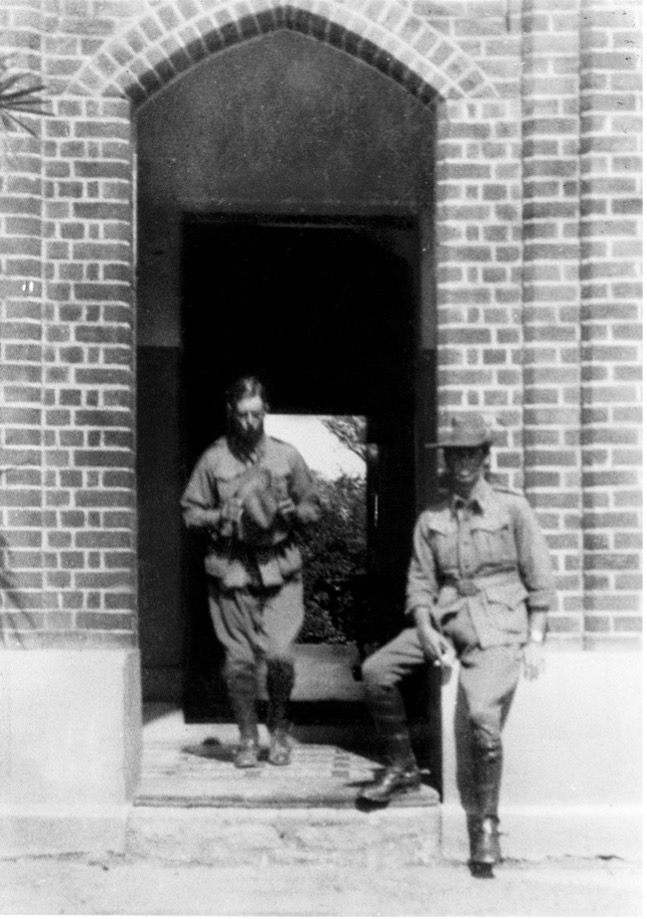
The photograph shows Wilfred and his brother Gresley on their last leave at Woodbridge.
“To live in hearts we leave behind is not to die.” – Thomas Campbell
Hannah Spencer
Heritage Officer